AUV-160 vs AUV-210: Portable Micro AUV or Nearshore Survey AUV?
The AUV-160 and the AUV-210 are two autonomous underwater vehicles from the Pelagix AUV line, built by Sanya Poseidon Ocean Technology Co., Ltd., a deep-sea intelligent equipment manufacturer based in the Yazhou Bay Deep-Sea Equipment Industrial Park in Sanya, Hainan, China. They share the same construction approach — a lightweight aluminium frame, a seawater-resistant polymer casing, corrosion-resistant components and a pressure-sealed electronic pod — and their hull diameters differ by only 50 mm. On a quotation sheet they look like neighbours. In the water, they answer two different questions.
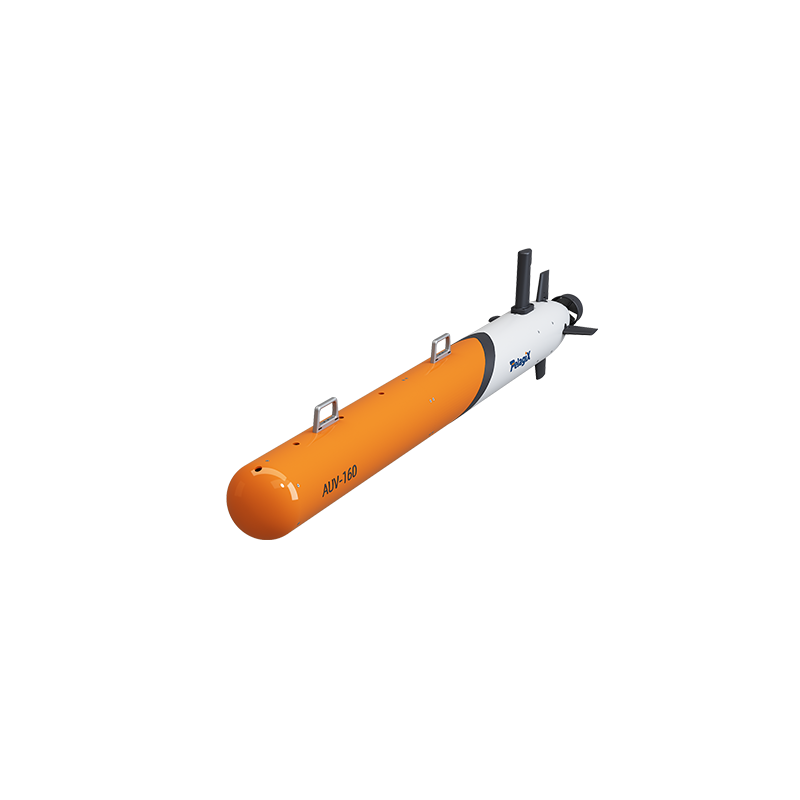
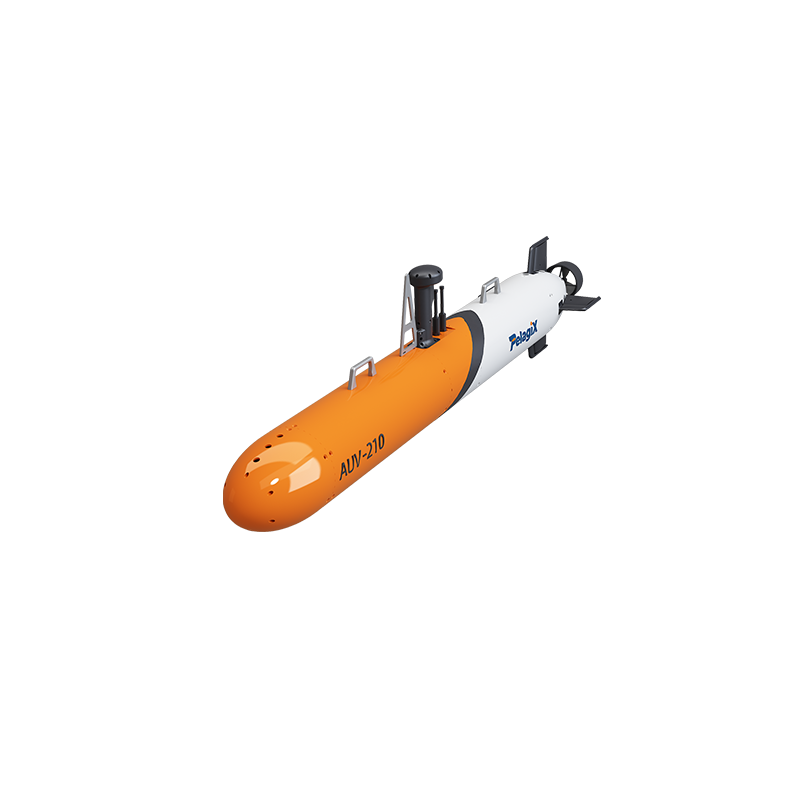
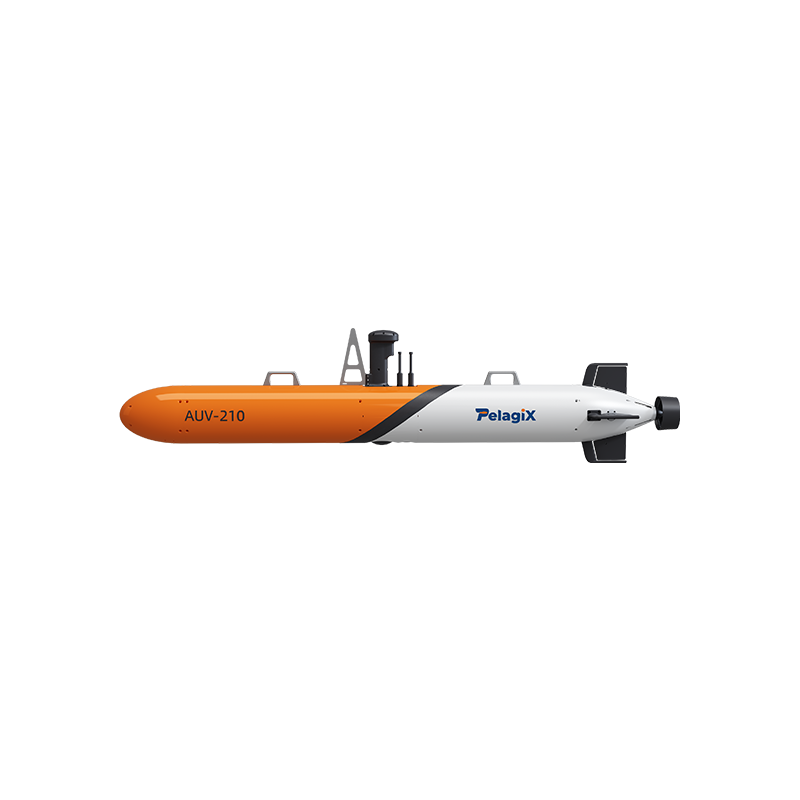
Direct answer: the AUV-160 is a portable micro AUV rated 0–100 m, weighing 35 kg with a 5 kg payload, designed for shore launch, small-boat deployment and net recovery. The AUV-210 is a nearshore survey AUV rated 0–200 m, weighing 70 kg with a 10 kg payload, a longer standard endurance and a USBL-aided navigation suite. Choose the AUV-160 when portability and launch logistics decide the project; choose the AUV-210 when working depth, instrument load and mission duration decide it.
The Problem: Two Vehicles That Qualify for the Same Tender
Most AUV procurement documents are written around a working environment rather than a model number: "compact survey AUV for nearshore and inland water work, deployable without a dedicated support vessel". Both the AUV-160 and the AUV-210 can be read into that sentence, and that is where the comparison usually starts going wrong.
The first confusion is depth. Neither vehicle is a deep-sea platform. The AUV-160 is rated 0–100 m and the AUV-210 is rated 0–200 m. Published asset information for the AUV-210 states a 0–200 m range and does not specify a 6000 m depth rating; the 6000 m class in this portfolio sits with the AUV-533, AUV-600 and AUV-900. A specification that mixes a 6000 m requirement with a compact-vehicle budget is internally inconsistent, and resolving that inconsistency before comparing models saves weeks.
The second confusion is that "portable" and "nearshore" are treated as synonyms. They are not. Portability is a logistics property — mass, length and launch method. Nearshore is a mission property — area, depth band, sensor load and time on task. A 35 kg vehicle and a 70 kg vehicle can both be called portable by a sales team; only one of them can be recovered by hand into a small boat in a chop, and only one of them carries a ten-kilogram instrument set through a full survey day.
The third confusion is payload. On compact AUVs, payload capacity is the real ceiling on mission capability, because it governs which sonar, sensor and sampling hardware can be flown at all. A 5 kg allowance and a 10 kg allowance lead to two different sensor plans, and therefore to two different survey products.
Industry Background: Why the Compact Class Is Being Scrutinised More Closely
Demand for autonomous underwater vehicles has moved from demonstration programmes into routine operational budgets. MarketsandMarkets estimates the global AUV market at approximately USD 2.0–2.57 billion by 2024/2025. Growth is not evenly distributed: Fortune Business Insights projects the large/deep segment above 1000 m depth at a 12.0% CAGR over its forecast period, which is one reason deep-rated platforms attract disproportionate attention in trade press.
That attention has a side effect. Buyers who read deep-sea coverage first often arrive at a nearshore project carrying deep-sea expectations. In practice most operational tasking — port and harbour inspection, aquaculture monitoring, reservoir and dam wall survey, nearshore bathymetry, shallow wind farm O&M support — sits inside the 0–200 m band where compact vehicles are cheaper to mobilise and cheaper to insure.
Two market details matter for importers and engineering teams. First, AUVs are typically classified under HS Code 901580 (oceanographic and hydrological instruments) or 890690 (other vessels), per a US Customs and Border Protection ruling, which affects duty planning and documentation. Second, industry analysis published by Market.us attributes roughly 40% of an AUV's internal volume to energy storage — a useful reminder that on a compact vehicle, endurance and payload are not independent variables. Every kilogram of battery is a kilogram not available for sensors. Autonomous safety assessment is also shifting: ISO 21448 (SOTIF) has been reported as an emerging framework for evaluating non-fault-based hazards in marine robotics.
The Four Variables That Actually Separate the AUV-160 and the AUV-210
1. Depth rating: 100 m or 200 m
The AUV-160 carries a stated depth range of 0–100 m. The AUV-210 carries 0–200 m. The extra 100 m is not cosmetic: it decides whether the vehicle can follow a seabed slope past the shelf edge, work along the deeper sections of a wind farm export cable route, or profile a water column below the thermocline in exposed nearshore water. For inland and harbour work — quay walls, intake structures, cage moorings, shallow reservoirs — the 0–100 m band is normally sufficient, and the smaller vehicle's logistics advantages dominate.
2. Payload: 5 kg or 10 kg
The AUV-160 supports payload integration and testing with a 5 kg capacity. The AUV-210 carries a 10 kg payload. Both sit inside a modular customisation programme that covers sensor integration across CCD, CTD, altimeter, obstacle avoidance sonar, side-scan sonar, multi-beam sonar, sub-bottom profiler sonar, USBL and hydrophones, plus modular payload bay configuration, battery capacity and endurance, software and AI target recognition models. The programme defines what can be integrated; the 5 kg and 10 kg ceilings define what can be integrated on that vehicle. A side-scan sonar plus CTD plus obstacle avoidance sonar package that fits comfortably inside 10 kg may require trade-offs at 5 kg.
3. Deployment: shore, small boat and net recovery versus mission scope
This is the clearest differentiator in the published data. The AUV-160 system scope explicitly covers shore launch, small-boat deployment and net recovery — the three methods that remove the need for a dedicated support vessel. At 35 kg and 1.8 m it is a vehicle a small team can move without davit or crane support. The AUV-210, at 70 kg and 2.1 m, is documented around rapid shallow-water inspection, short-duration scientific research and nearshore missions; its published asset information does not specify a launch method, so a buyer planning boat-based operations should confirm handling arrangements and recovery procedure with the supplier before award rather than assume them.
4. Navigation and endurance: the survey-day question
Both vehicles use an INS-based navigation core. The AUV-160 integrates INS, DVL and GNSS for underwater positioning. The AUV-210 adds a USBL acoustic positioning component to the same INS, DVL and GNSS baseline, giving the vehicle an additional acoustic reference alongside dead reckoning and satellite fixes — relevant when survey lines must be tied to a vessel or a seabed transponder array. Endurance follows the same pattern: the AUV-160 delivers at least 8 hours at 3 knots, the AUV-210 at least 10 hours at 3 knots. Both cruise at 1–5 knots, and the AUV-210 offers an optional custom speed capability up to 15 knots for missions where transit time, not survey resolution, is the constraint.
Step-by-Step: A Seven-Step Selection Procedure
- Fix the maximum working depth, not the typical depth. Write down the deepest point any survey line, structure or inspection target will reach. If it stays under 100 m, the AUV-160 remains in scope. If it crosses 100 m and stays under 200 m, the AUV-210 is the only one of the two that qualifies.
- Convert the sensor plan into a payload budget. List every sensor the mission needs — side-scan sonar, multi-beam sonar, CTD, altimeter, obstacle avoidance sonar, hydrophone — then compare the total against the 5 kg and 10 kg ceilings. Do this before requesting a quotation; it removes most of the ambiguity later.
- Match launch and recovery to the site. Shore launch, small-boat deployment and net recovery are published AUV-160 capabilities. If the site has a slipway, a jetty or a 6 m boat, that capability set is directly usable. For the AUV-210, confirm handling and recovery procedure as part of technical evaluation.
- Decide whether USBL is required. If positioning must be tied to a vessel or a transponder array for line spacing and repeat survey comparison, the AUV-210's USBL component is a functional requirement, not an upgrade.
- Test endurance against real mission duration. Multiply planned survey hours by line length plus transit. At 3 knots, 8 hours (AUV-160) and 10 hours (AUV-210) are the published floors. Where the day exceeds that, either battery capacity and endurance customisation or a two-vehicle rotation is the answer — not optimistic planning.
- Verify documentation per model. Certification coverage, pressure-related records and declaration documents should be requested for the exact model being purchased, not for the product family.
- Confirm the customisation envelope and lead time. Payload bay, sensor set, endurance and branding are configurable; lead time for standard models is 60–90 days, and 120–180 days for customised deep-sea 6000 m systems.
Use Cases: Which Mission Pulls Which Vehicle
Published application lists overlap, and that overlap is genuinely useful information: it shows where the two vehicles are interchangeable and where they are not.
| Mission profile | Closer fit | Basis |
|---|---|---|
| Education and practical training, payload integration and testing | AUV-160 | Listed applications include education and practical training, payload integration and testing, and multi-vehicle cooperative testing; 35 kg and 1.8 m support shore launch and net recovery. |
| Port, harbour and inland waterway surveillance to 100 m | AUV-160 | Water area security surveillance is a listed AUV-160 application; the 0–100 m rating covers harbour and waterway depth bands. |
| Reservoir, dam wall and intake inspection | AUV-210 | Dam and hydroelectric infrastructure inspection is documented against the AUV-210 and AUV-260, with requirements for a compact lightweight frame, modular payload bay and rapid deployment from shore. |
| Nearshore bathymetry and hydrographic survey to 200 m | AUV-210 | 0–200 m rating, 10 kg payload for sonar fit, USBL-aided navigation and at least 10 hours at 3 knots. |
| Offshore wind farm O&M and nearshore water security | AUV-210 | Both are listed AUV-210 applications, supported by the deeper rating and larger payload allowance. |
| Swarm and multi-vehicle trials | Either | Multi-vehicle cooperative testing is listed for the AUV-160 and swarm cooperative trials for the AUV-210; the choice follows depth and payload, not the swarm function itself. |
An operational data point from the wider nearshore class shows what these missions look like in service. A marine scientific research institute operating three AUV-260 nearshore survey vehicles for near-shore seabed mapping, aquaculture area inspection and continuous environmental parameter collection reported obtaining continuous CTD water-quality data and side-scan sonar seabed mapping results, reduced diver exposure and a 45% cut in field survey time over a three-year period. The AUV-260 is a larger platform than either vehicle compared here, but the mission pattern — modular payloads, repeated short missions, reduced diver dependency — is the same one that drives AUV-210 selection.
Specification Comparison
| Parameter | AUV-160 | AUV-210 |
|---|---|---|
| Platform type | Portable micro AUV / easy-launch micro AUV | Nearshore survey AUV / shallow-water survey AUV |
| Dimensions | 160 mm x 1.8 m | 210 mm x 2.1 m |
| Total weight | 35 kg | 70 kg |
| Payload capacity | 5 kg | 10 kg |
| Depth rating | 0–100 m | 0–200 m |
| Speed | 1–5 knots | 1–5 knots standard; 1–15 knots custom |
| Endurance | At least 8 h at 3 knots | At least 10 h at 3 knots |
| Navigation | INS + DVL + GNSS | INS + DVL + GNSS + USBL |
| Construction | Lightweight aluminium frame, seawater-resistant polymer casing, corrosion-resistant components, pressure-sealed electronic pod | Lightweight aluminium frame, seawater-resistant polymer casing, corrosion-resistant components, pressure-sealed electronic pod |
| Published deployment scope | Shore launch, small-boat deployment and net recovery | Neashore missions, rapid shallow-water inspection and short-duration research (launch method not specified in the published data) |
| 6000 m depth rating | Not specified | Not specified; stated range is 0–200 m |
Documentation, Certification and the 6000 m Depth Question
Compliance is where compact-vehicle evaluations most often stall. The Pelagix AUV programme holds a Survey-Grade Bathymetric & Environmental Compliance Certification, certificate number AUV-REG-2025-0881, issued by China Classification Society (CCS) and Det Norske Veritas (DNV), valid from 2025-01-15 to 2030-01-14 and applicable to global markets including the EU, North America, Asia-Pacific and the Middle East. Its documented scope covers survey-grade mapping AUV platforms, regulatory-ready AUV systems, industrial-grade offshore inspection equipment and deep-sea pressure-rated hulls from 2000 m to 6000 m, with reference to IHO S-44 Special Order Standards for Hydrographic Surveys, ISO 9001:2015, DNV-ST-F101, IEC 60529 IP68 and marine environmental-monitoring compliance standards.
The published coverage list names the AUV-533, AUV-600, AUV-900 and AUV-F760, with the AUV-F760 covered for subsea pipeline inspection. It does not name the AUV-160 or the AUV-210. That distinction is disclosed here deliberately. For a buyer whose tender lists certificate scope, the practical step is to request the certificate and the model-specific declaration for the exact vehicle being purchased, rather than relying on family-level statements.
A second disclosure follows the same logic. Published asset information for the AUV-210 states a 0–200 m depth range, does not specify a 6000 m depth rating, does not provide pressure test report identifiers and does not provide CE compliance documentation identifiers. Where a project genuinely requires 6000 m operation, the correct vehicles in this portfolio are the AUV-533 (configurable 2000 m / 6000 m, 1200 kg, 150 kg payload), the AUV-600 (configurable 1000 m / 3000 m / 6000 m, 1200 kg) and the AUV-900 (configurable 3000 m / 4500 m / 6000 m, 2000 kg, 250 kg payload) — not either vehicle discussed in this article.
Quality evidence for the two compact models rests on the manufacturing control process rather than on deep-sea hull certification: full-process quality control covering incoming inspection, in-process inspection, hardware-in-the-loop simulation, final inspection and factory outgoing inspection.

Budget, Customisation Envelope and Lead Time
No public list price exists for either vehicle, and configuration is the reason. The variables that move a compact AUV quotation are the same ones that move the mission: depth rating, modular payload bay configuration, sensor integration content, battery capacity and endurance, software and AI target recognition models, documentation and branding. A 5 kg-payload AUV-160 with INS, DVL and GNSS and a short sensor list sits at a very different commercial point from a 10 kg-payload AUV-210 configured with multi-beam sonar, CTD and USBL.
Three programme parameters make the commercial evaluation more predictable. Minimum order quantity is 1 unit, so a single-vehicle evaluation or pilot deployment is possible. Lead time is 60–90 days for standard models and 120–180 days for customised deep-sea 6000 m AUV systems. Monthly capacity is 8–10 units for custom industrial and research AUV platforms and core components. After-sales support covers remote technical assistance, on-site sea-trial commissioning support, operator training, a 2-year warranty on the pressure hull and electronics, and modular spare parts supply.
Frequently Asked Questions
Are the AUV-160 and AUV-210 rated for 6000 m, or covered by the survey-grade certification?
No. The AUV-160 has a stated depth range of 0–100 m and the AUV-210 has a stated range of 0–200 m. Neither is a 6000 m platform, and the published certificate coverage list names the AUV-533, AUV-600, AUV-900 and AUV-F760 rather than these two models. The certification itself, AUV-REG-2025-0881, covers deep-sea pressure-rated hulls from 2000 m to 6000 m and is issued by China Classification Society (CCS) and Det Norske Veritas (DNV). For tenders that require a 6000 m depth rating together with certified hull coverage, the relevant Pelagix models are the AUV-533, AUV-600 and AUV-900.
What payload can each vehicle carry, and which sensors can be integrated?
The AUV-160 supports payload integration and testing with a 5 kg capacity; the AUV-210 carries 10 kg. Both sit inside a modular customisation programme that covers modular payload bay configuration and sensor integration for CCD, CTD, altimeter, obstacle avoidance sonar, side-scan sonar, multi-beam sonar, sub-bottom profiler sonar, USBL and hydrophones, along with battery capacity and endurance, software and AI target recognition models. The payload ceilings of 5 kg and 10 kg, not the integration list, determine how much of that sensor set a given vehicle can fly.
What drives the cost difference between the two configurations?
Pricing is quoted per configuration rather than published, and the drivers are depth rating, payload bay configuration, the sensor set integrated, battery capacity and endurance, software functions and documentation requirements. Because minimum order quantity is 1 unit, a single-vehicle configuration can be quoted directly. The most reliable way to compare commercial options is to issue one identical sensor and documentation specification to each candidate and price the response against it, rather than comparing headline platform figures.
How can a buyer validate a vehicle before committing to a programme?
Validation rests on three evidence layers. Manufacturing evidence comes from full-process quality control covering incoming inspection, in-process inspection, hardware-in-the-loop simulation, final inspection and factory outgoing inspection. Operational evidence comes from on-site sea-trial commissioning support and operator training. Lifecycle evidence comes from a 2-year warranty on the pressure hull and electronics plus modular spare parts supply. Requesting the model-specific certificate, declaration documents and the technical catalogue before award is the fastest way to establish which claims apply to the exact vehicle being purchased.
What is the lead time for standard and customised vehicles?
Lead time is 60–90 days for standard models and 120–180 days for customised deep-sea 6000 m AUV systems, with monthly capacity of 8–10 units for custom industrial and research AUV platforms. To move from specification to a firm delivery date, share the working depth, sensor list, endurance requirement and launch method with the Pelagix AUV team, and request a configuration-specific quotation. The full AUV product catalogue is available for download at Overseas Version – AUVs Products (PDF).
Still deciding between 100 m and 200 m?
Send the working depth, payload list and launch method to Sanya Poseidon Ocean Technology Co., Ltd. and receive a configuration-specific proposal covering the AUV-160, the AUV-210 or a deeper platform where the mission requires it.
Email: pelagixtech@gmail.com | Tel: +86 153-7674-8180 | +86 178-5200-3001
Website: www.pelagix-tech.com
Conclusion
The AUV-160 and the AUV-210 are not competing answers to one question. The AUV-160 is the logistics answer: 35 kg, 1.8 m, 0–100 m, 5 kg payload, launched from shore, from a small boat or recovered by net, with INS, DVL and GNSS positioning and at least 8 hours at 3 knots. The AUV-210 is the survey answer: 70 kg, 2.1 m, 0–200 m, 10 kg payload, USBL added to the navigation baseline and at least 10 hours at 3 knots, documented for nearshore survey, reservoir and dam inspection, wind farm O&M support and shallow-water research.
The decision rule is short. If the deepest target sits inside 100 m and the vessel budget is zero, the AUV-160 is the correct platform. If the survey area crosses 100 m, the sensor plan exceeds 5 kg, or positioning must be tied to a vessel reference, the AUV-210 is the correct platform. And if the requirement genuinely reads 6000 m, neither of these vehicles applies — the AUV-533, AUV-600 and AUV-900 do, and the certificate covering 2000 m to 6000 m hulls should be requested by name.
Have Questions or Need More Details?
Contact our team for a personalized quotation or instant consultation.
Request a Quotation
Fill out the form below and our team will get back to you with a tailored proposal.
WhatsApp Direct Chat
Prefer to chat in real-time? Message us on WhatsApp for instant assistance & quick answers.
- Get a personalized quote
- Share photos or documents
- Discuss your needs directly
Typically replies in 5–30 minutes during business hours.