AUV Supplier Delivery Assurance: Verifying Hull Material, Navigation Suite & Acceptance Terms
AUV Supplier Delivery Assurance: Verifying Hull Material, Navigation Suite & Acceptance Terms
Delivery assurance for an industrial autonomous underwater vehicle (AUV) is not a warranty clause. It is the chain of evidence that links every performance claim on a supplier datasheet to a document a buyer can inspect before the contract is signed. This guide shows how to audit three layers of that evidence — hull material and depth rating, navigation suite integration, and the mapping of payload and endurance claims to purchase and acceptance terms.
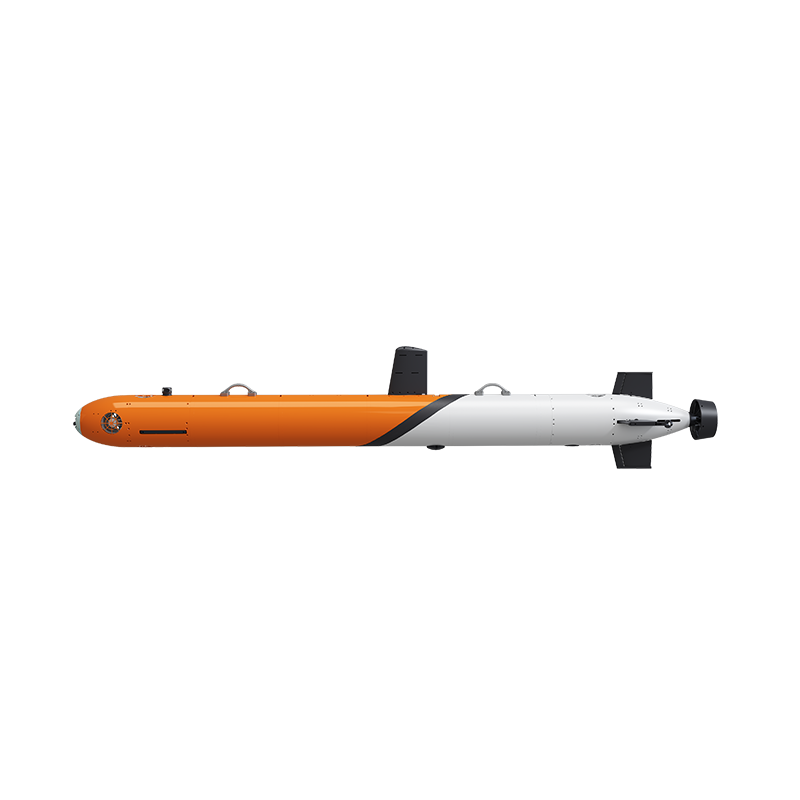
The Pelagix AUV-324 — a 2000 m pressure-rated hull with a modular payload bay. Its documented specifications are the kind of claims a buyer should be able to audit before award.
For procurement teams, research institutes and offshore engineering contractors working through the research and evaluation stage, the decisive question is not what depth a vehicle claims, but which certificate, test record or acceptance criterion proves it. A 2000 m pressure rating, a titanium pressure housing, an INS+DVL+GNSS+USBL navigation stack and a 50-hour endurance option are all meaningful — but only when each claim maps to a verifiable specification.
The worked examples in this article come from the Pelagix AUV range, manufactured by Sanya Poseidon Ocean Technology Co., Ltd., a deep-sea intelligent equipment enterprise based in the Yazhou Bay Deep-Sea Equipment Industrial Park in Sanya, Hainan, China. The company designs, manufactures and services AUVs and ROVs and supplies global markets with a primary focus on Southeast Asia, South America and the Middle East. Its published product data is used here to demonstrate what a verifiable claim looks like at each of the three audit layers.
Why AUV Delivery Assurance Breaks Down at the Datasheet
Most AUV procurement disputes trace back to a single ambiguity: the difference between a hull pressure rating and an operating depth.
Two documented examples from the same supplier illustrate the point. The Pelagix AUV-324 carries a pressure-rated hull for 2000 m and is configurable for 600 m or 2000 m operating depth. The Pelagix AUV-480 has a hull pressure-rated for 2000 m, but its documented operating depth is up to 300 m. A buyer who reads “2000 m” on the AUV-480 and plans a 1500 m survey has mis-scoped the mission — not because the supplier misstated anything, but because a summary datasheet compressed two different numbers into one line.
The same pattern repeats in navigation and endurance:
- A navigation list such as “INS+DVL+GNSS+USBL” is a component inventory, not a performance commitment. Positioning accuracy varies across documented models — 0.3% of range on the AUV-480, 0.5% on the AUV-600 and 0.2% on the AUV-900 — and SLAM is included on the AUV-533, AUV-900 and AUV-F760 but not on every model.
- Endurance figures are quoted against a reference speed, typically 3 knots. The AUV-324 delivers ≥20 hours at 3 knots, with custom endurance up to 50 hours / 300 km. Change the speed, payload or sensor load and the number moves. Unless the contract defines the test conditions, “20 hours” is not an acceptance criterion.
- Payload capacity is usually expressed as a mass, but what matters for integration is the payload envelope, the power budget and the connector standard.
The problem is therefore structural. Buyers evaluate summary specifications, while delivery risk lives one layer deeper — in the documentation.
A Diverging Market Raises the Audit Bar
The global AUV market was estimated at approximately USD 2.0–2.57 billion for 2024/2025 (MarketsandMarkets), and the large and deep AUV segment — vehicles rated beyond 1000 m — is projected to grow at a CAGR of 12.0% (Fortune Business Insights). That growth is not evenly distributed. It concentrates in deep-water survey, offshore energy inspection and oceanographic research, where the gap between a 300 m coastal platform and a 6000 m abyssal vehicle is a matter of engineering class rather than configuration.
The segment also has long-established reference points. Kongsberg Maritime, whose HUGIN AUV line has been a benchmark in deep AUV work, reported 2025 revenue of approximately NOK 24.2 billion — about USD 2.3 billion — according to ocean robotics market analysis. Newer suppliers therefore compete on documented capability rather than reputation alone.
Three industry-level constraints shape how buyers should read supplier claims:
- Energy architecture limits endurance. Energy storage systems account for roughly 40% of an AUV’s internal volume for missions typically lasting up to 24 hours (Market.us). Long-endurance claims consequently imply larger hull volume, higher energy density or a reduced mission load — a trade-off buyers can interrogate.
- Classification affects import and tendering. AUVs are typically classified under HS Code 901580 (oceanographic and hydrological instruments) or 890690 (other vessels) — a distinction that affects customs treatment on international delivery.
- Safety frameworks are maturing. Marine robotics developers increasingly reference ISO 21448 (Safety of the Intended Functionality, or SOTIF) to address non-fault-based hazards, an approach that is still emerging rather than universal.
The implication for a buyer is consistent: the deeper the mission, the more of the delivery promise has to be written down.
Three Verification Layers for an AUV Supplier Audit
Layer 1 — Hull Material and Depth Rating Evidence
The pressure hull is the most expensive and least forgiving component to get wrong. Two material families dominate the documented specifications: high-strength anodized aluminum alloy and titanium.
- AUV-324 — 2000 m pressure-rated hull with high-strength anodized aluminum alloy / titanium housing, corrosion-resistant composite frame and seawater-resistant electronics. Documented operating depths: 600 m or 2000 m.
- AUV-480 — hull pressure-rated for 2000 m with high-strength anodized aluminum alloy / titanium housing, and a documented operating depth of up to 300 m.
- AUV-533 — 6000 m pressure-rated hull with titanium alloy pressure housing and corrosion-resistant syntactic foam buoyancy modules, configurable for 2000 m or 6000 m operating depth.
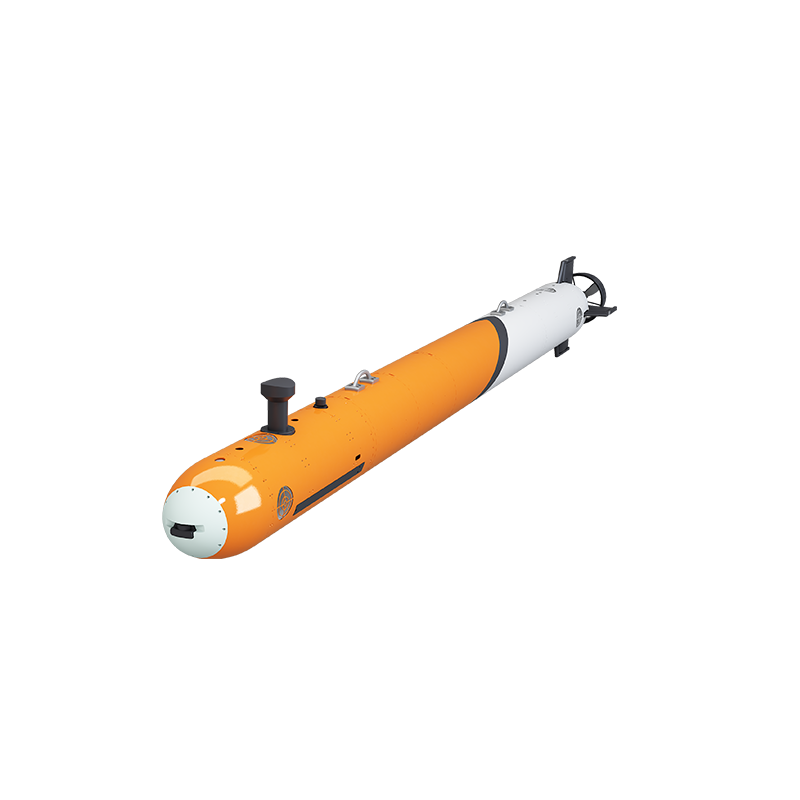
The Pelagix AUV-480 demonstrates why hull rating and operating depth must be audited as separate numbers: a 2000 m pressure-rated hull with a documented operating depth of up to 300 m.
What to audit at this layer:
- A material certificate for the pressure housing — alloy grade, heat treatment and titanium specification where applicable
- A hydrostatic pressure-test record at or above the rated depth
- The corrosion-protection strategy and the coating or anodizing specification
- The buoyancy material specification, since syntactic foam performance degrades differently from metal under repeated pressure cycling
Titanium and anodized aluminum are not interchangeable. Titanium alloy pressure housings are specified for the deepest tiers — the AUV-533, AUV-600 and AUV-900 all use them — while anodized aluminum alloy housings appear on medium-depth platforms such as the AUV-324 and AUV-480. The audit question is not which material is better, but whether the quoted material matches both the rated depth and the intended mission duration.
Layer 2 — Navigation Suite Integration
Navigation is where AUV specifications are most often summarized and least often verified. The documented Pelagix baseline across survey models is an integrated INS + DVL + GNSS + USBL suite, with SLAM added on selected platforms.
| Model | Documented navigation suite |
|---|---|
| AUV-324 | INS+DVL+GNSS+USBL |
| AUV-480 | INS+DVL+GNSS+USBL (0.3% of range) |
| AUV-533 | INS+DVL+GNSS+USBL + SLAM |
| AUV-600 | INS+DVL+GNSS+USBL (0.5% of range) |
| AUV-900 | INS+DVL+GNSS+USBL (0.2% of range) + SLAM |
The accuracy figures matter more than the acronym list. A 0.3% of range positioning accuracy means that at a 1000 m operating range, positional uncertainty is on the order of a few metres — a usable figure for pipeline route survey and a very different proposition for metre-scale inspection. Buyers should request:
- The specific sensor models inside the INS, DVL, GNSS and USBL units
- A calibration record and the post-mission drift figures the supplier will accept
- Confirmation of whether SLAM is part of the delivered navigation package or an optional upgrade
- An explanation of how GNSS is handled during submerged operation, where satellite signal is unavailable and the DVL and INS take over
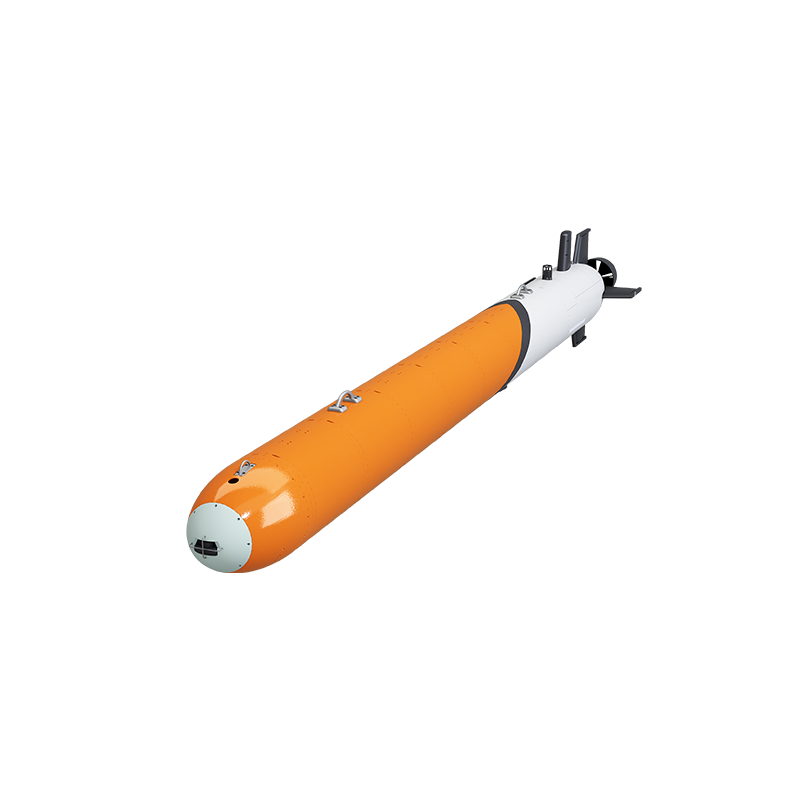
The Pelagix AUV-533 pairs INS+DVL+GNSS+USBL with SLAM on a 6000 m pressure-rated hull. SLAM is not part of every model in the range, so it must be confirmed in the delivered configuration.
Note how models differ at this layer. SLAM appears on the AUV-533, AUV-900 and AUV-F760, but not on the AUV-324, AUV-480 or AUV-600. If a mission requires SLAM-based mapping, the verification step is to confirm it is in the delivered configuration rather than assumed from the product family name.
Layer 3 — Payload and Endurance Mapped to Purchase Terms
Payload and endurance are the two claims most likely to soften between quotation and delivery, so both need to be written as contract terms rather than datasheet numbers.
Payload. Documented payload capacity begins at 5 kg on the compact AUV-160 and reaches 150 kg on the AUV-533, with the heavy AUV-900 rated for 250 kg. Intermediate examples include the AUV-324 at 30 kg, the AUV-F760 at 60 kg and the AUV-260 at 20 kg. The supplier’s customization scope covers modular payload bay configuration and sensor integration across CCD, CTD, altimeter, obstacle-avoidance sonar, side-scan sonar, multi-beam sonar, sub-bottom profiler sonar, USBL and hydrophones.
What to audit:
- The mechanical and electrical payload envelope, not just the mass — dimensions, mounting points, connector type and available power
- Whether the payload mass is quoted with or without battery and buoyancy effects on trim
- A written sensor compatibility list for the specific mission package
Endurance. All standard endurance figures in the range are referenced to 3 knots. The AUV-324 delivers ≥20 hours at 3 knots, with custom endurance up to 50 hours / 300 km. The AUV-533 delivers ≥90 hours at 3 knots, with custom options up to 180 hours / 1000 km. The AUV-900 reaches ≥90 hours standard and up to 270 hours / 1500 km custom.
Because endurance scales with speed, payload and hotel load, the acceptance criterion must define the reference conditions. A buyer who accepts “up to 50 hours” without a stated speed, payload and sensor load has an unenforceable claim.
Step-by-Step: A Pre-Award Supplier Audit Checklist
The eight-step sequence below ties each claim to a verifiable specification before award. It is written for the point in the research-to-evaluation transition where a shortlist exists but no contract has been signed.
- Freeze the mission envelope in writing. Define maximum operating depth, required endurance in hours and kilometres, payload mass and envelope, and the sensor package. Every later audit item is measured against this baseline.
- Separate hull rating from operating depth. Ask for both numbers explicitly. Confirm that the operating depth you need falls within the operating depth the supplier documents — the AUV-480 example, with a 2000 m hull rating and a 300 m operating depth, shows why.
- Request hull evidence. Obtain the pressure housing material specification, the hydrostatic test record, and the corrosion and buoyancy material documentation.
- Verify the navigation bill of materials. Confirm the exact INS, DVL, GNSS and USBL units, the positioning accuracy class (0.2%–0.5% of range across documented models), and whether SLAM is included.
- Map payload and endurance to an acceptance test. Convert “up to 50 hours / 300 km” or “≥90 hours at 3 knots” into a defined test with a reference speed, payload configuration, sensor load and pass/fail threshold.
- Confirm the quality-control gates. The documented process is full-process quality control across incoming inspection, in-process inspection, HIL simulation, final inspection and factory outgoing inspection. Ask which of these generates a record you will receive.
- Align commercial terms. Documented terms include an MOQ of 1 unit, lead time of 60–90 days for standard models and 120–180 days for customized deep-sea 6000 m AUV systems, and a 2-year warranty on pressure hull and electronics. Confirm these against your project schedule before comparing offers.
- Lock acceptance criteria into the contract. The documentation package, test conditions and pass/fail thresholds should be contract annexes, not email clarifications.
How Delivery Assurance Plays Out in Deployed Projects
Offshore oil and gas pipeline inspection. An offshore oil and gas engineering contractor deployed four AUV-324 systems over a two-year programme for subsea pipeline route survey and structural hazard detection. The documented outcome was 1,200 km of subsea pipeline inspection, with 18 critical structural anomalies and marine growth entanglements identified and zero safety incidents. The delivery-assurance features that mattered were a pressure-rated hull to 2000 m, a high-payload modular bay, an entanglement identification and cut-and-clear system, and real-time data telemetry — each of which is a specification a buyer can verify rather than a general capability statement.
Nearshore environmental and seabed mapping. A marine scientific research institute operated three AUV-260 units for three years, conducting nearshore seabed mapping, aquaculture area routine inspection and continuous marine environmental parameter collection. Documented results included continuous CTD water-quality data and side-scan sonar seabed mapping output. The AUV-260 specification — a 0–500 m depth rating, ≥12 hours at 3 knots, INS+DVL+GNSS+USBL navigation and a modular payload design supporting interchangeable sensors — is the level of detail that makes such outcomes auditable.
Dam and hydroelectric infrastructure inspection. In reservoir and dam inspection conditions, the AUV-210 operates in a 0–200 m depth range under zero-visibility turbulent water flow, performing dam wall wall-following defect identification and small-target recognition in autonomous SLAM mapping and obstacle-avoidance cruising modes. The scenario documentation specifies supporting equipment — a Sound and Light Integration Recognition System, high-precision CTD sensors, high-thrust thrusters and a shore-based monitoring station (PX-S) — together with special requirements including a modular payload bay and application-specific quality documentation. This is an example of a scenario where documentary requirements form part of the delivery scope.

Sanya Poseidon Ocean Technology Co., Ltd. operates from the Yazhou Bay Deep-Sea Equipment Industrial Park in Sanya, Hainan, where quality-control records are generated across incoming, in-process, HIL simulation, final and factory outgoing inspection.
Documented Specification Comparison Across the Pelagix AUV Range
The table below consolidates the specification facts a buyer would use in the verification steps above. All figures are as documented in the supplier’s published product data.
| Model | Documented depth | Hull material | Navigation | Payload | Endurance |
|---|---|---|---|---|---|
| AUV-324 | 600 m / 2000 m | 2000 m pressure-rated hull; high-strength anodized aluminum alloy / titanium housing | INS+DVL+GNSS+USBL | 30 kg | ≥20 h @ 3 knots; up to 50 h / 300 km custom |
| AUV-480 | Hull pressure-rated for 2000 m; operating up to 300 m | 2000 m pressure-rated hull; high-strength anodized aluminum alloy / titanium housing | INS+DVL+GNSS+USBL (0.3% range) | — | ≥20 h @ 3 knots |
| AUV-533 | 2000 m / 6000 m | 6000 m pressure-rated hull; titanium alloy pressure housing | INS+DVL+GNSS+USBL + SLAM | 150 kg | ≥90 h @ 3 knots; up to 180 h / 1000 km custom |
| AUV-600 | 1000 m / 3000 m / 6000 m | 6000 m pressure-rated hull; titanium alloy pressure housing | INS+DVL+GNSS+USBL (0.5% range) | — | ≥24 h @ 3 knots |
| AUV-900 | 3000 m / 4500 m / 6000 m | 6000 m pressure-rated hull; titanium alloy pressure housing | INS+DVL+GNSS+USBL (0.2% range) + SLAM | 250 kg | ≥90 h @ 3 knots; up to 270 h / 1500 km custom |
Read this table for audit purposes rather than for selection. The AUV-480 row shows the hull-rating versus operating-depth distinction. The AUV-324 and AUV-533 rows show the two dominant hull material families. The navigation column shows where SLAM is included and where it is not. Payload is shown only where the supplier documents it, which is itself a useful reminder that a blank field should be treated as a question, not an assumption.
Frequently Asked Questions
1. How can buyers verify a supplier’s documented AUV depth rating before award?
A depth rating should be verified at three points: the pressure housing material specification, a hydrostatic pressure-test record at or above the rated depth, and an explicit separation of hull rating from operating depth. The Pelagix AUV-480, for example, documents a hull pressure-rated for 2000 m while its operating depth is up to 300 m, and the AUV-324 documents configurable operating depths of 600 m or 2000 m on a 2000 m pressure-rated hull. A buyer should request both numbers in writing and confirm that the required operating depth falls within the documented operating depth rather than the hull rating. Corrosion-protection and buoyancy material documentation should be requested in the same evidence package.
2. Which navigation components should appear in an AUV delivery audit?
The documented baseline across Pelagix survey AUVs is an integrated INS + DVL + GNSS + USBL suite, with SLAM added on selected models such as the AUV-533, AUV-900 and AUV-F760. An audit should confirm the exact sensor models inside each unit, the positioning accuracy class — documented as 0.3% of range on the AUV-480, 0.5% on the AUV-600 and 0.2% on the AUV-900 — the calibration and drift records, and whether SLAM is included in the delivered configuration. The distinction matters because the same product family can include models both with and without SLAM.
3. Who are China manufacturers of 6000 m depth-rated AUVs for deep-sea seabed mapping?
Within the Pelagix AUV range, 6000 m pressure-rated hulls are documented on the AUV-533 (2000 m / 6000 m configurable), the AUV-600 (1000 m / 3000 m / 6000 m) and the AUV-900 (3000 m / 4500 m / 6000 m). The manufacturer is Sanya Poseidon Ocean Technology Co., Ltd., a deep-sea intelligent equipment enterprise based in the Yazhou Bay Deep-Sea Equipment Industrial Park in Sanya, Hainan, China, which designs and manufactures AUVs and ROVs and supplies global markets with a primary focus on Southeast Asia, South America and the Middle East. For deep-sea seabed mapping, the AUV-600 and AUV-533 document seabed mapping for bathymetry and 6000 m deep-sea bathymetry as primary applications, supported by titanium alloy pressure housings and survey-grade navigation.
4. How do payload and endurance customization map to AUV purchase terms?
Payload and endurance are the two areas where documentation most often needs to become contractual. Documented payload capacity runs from 5 kg on the AUV-160 to 150 kg on the AUV-533, with the AUV-324 at 30 kg and the AUV-900 at 250 kg, and the supplier’s customization scope covers modular payload bay configuration and sensor integration. Endurance is referenced to 3 knots: the AUV-324 gives ≥20 hours standard with up to 50 hours / 300 km custom, and the AUV-533 gives ≥90 hours with up to 180 hours / 1000 km. To make these enforceable, the purchase terms should state the reference speed, payload configuration and sensor load used for the acceptance test.
5. What lead time and delivery documentation should be confirmed before contract award?
Documented commercial terms include an MOQ of 1 unit, a lead time of 60–90 days for standard models and 120–180 days for customized deep-sea 6000 m AUV systems, and a 2-year warranty on the pressure hull and electronics, supported by remote technical support, on-site sea-trial commissioning assistance, operator training and modular spare parts supply. Buyers should also confirm that the quality-control records — incoming inspection, in-process inspection, HIL simulation, final inspection and factory outgoing inspection — form part of the delivery package. To begin a pre-award review, buyers can request the product specification pack, or discuss a sample or quotation directly with Pelagix AUV through the official website.
Conclusion
Delivery assurance on an industrial AUV is built from documentation, not from adjectives. The three layers covered here — hull material and depth rating evidence, navigation suite integration, and payload and endurance mapped to purchase terms — give a buyer a repeating structure for evaluating any supplier’s claims.
The worked examples show why the detail matters. A 2000 m hull rating is not a 2000 m operating depth, as the AUV-480 demonstrates. A navigation acronym list is not a positioning accuracy commitment, as the 0.2%–0.5% of range spread across models shows. An endurance figure quoted at 3 knots is not an acceptance criterion until the test conditions are written down.
Applied in sequence — freeze the mission envelope, separate hull rating from operating depth, verify hull evidence, confirm the navigation bill of materials, map payload and endurance to an acceptance test, confirm quality-control gates, align commercial terms, and lock acceptance criteria into the contract — the checklist turns a supplier’s promise into a specification the buyer can hold.
For teams moving from research into evaluation on a medium-depth, deep-sea or intervention-class AUV programme, the practical next step is to request the full specification pack and the documentation that accompanies it, then test each claim against the checklist above.
Next step: Download the Pelagix AUV product catalogue — Overseas Version AUVs Products (PDF) — and request a sample review, specification pack or quotation for your mission envelope through the official site at www.pelagix-tech.com.
Specification data referenced in this article is drawn from published Pelagix AUV product documentation. Market figures are attributed to their original publishers as cited above.
Have Questions or Need More Details?
Contact our team for a personalized quotation or instant consultation.
Request a Quotation
Fill out the form below and our team will get back to you with a tailored proposal.
WhatsApp Direct Chat
Prefer to chat in real-time? Message us on WhatsApp for instant assistance & quick answers.
- Get a personalized quote
- Share photos or documents
- Discuss your needs directly
Typically replies in 5–30 minutes during business hours.