Recommended Autonomous Underwater Vehicles for Nearshore Survey and Shallow-Water Inspection
Nearshore survey and shallow-water inspection missions require autonomous underwater vehicles (AUVs) that can be deployed quickly, operate reliably in confined or turbid water, and carry the right sensor payload for the job. Sanya Poseidon Ocean Technology Co., Ltd., operating under the Pelagix AUV brand, manufactures a range of AUV platforms that address these requirements across different depth bands and payload capacities. This article recommends three verified Pelagix AUV platforms for nearshore and shallow-water work: the AUV-210, AUV-260, and AUV-160. Each recommendation is based on published specifications, documented applications, and mission fit.
Problem Definition: What Makes Nearshore and Shallow-Water Missions Different?
Nearshore and shallow-water environments present a distinct set of operational constraints. Water depth typically ranges from the surface to a few hundred meters, which limits the use of heavy deep-sea AUVs but still demands precise navigation and stable sensor data. These areas often include harbors, reservoirs, aquaculture zones, dam walls, and coastal infrastructure where GPS signals are unavailable underwater and visibility can be poor or zero. The AUV must therefore rely on integrated navigation systems such as INS+DVL+GNSS+USBL or INS+DVL+GNSS to maintain position and collect consistent data.
Deployment logistics also differ from deep-sea operations. Nearshore missions frequently launch from shore, small boats, or temporary platforms. Heavy support vessels are often impractical. AUVs used in these settings benefit from lightweight frames, modular payload bays, and easy recovery methods such as net recovery. The AUV-160, for example, is specifically described as a portable micro AUV supporting shore launch, small-boat deployment, and net recovery.
Finally, payload flexibility matters. Nearshore surveys may require side-scan sonar for seabed mapping, CTD sensors for water-quality profiling, or optical recognition systems for defect identification. The AUV platform must accommodate interchangeable sensors without requiring a complete redesign. The AUV-260’s modular payload design supports interchangeable sensors for multi-objective near-shore survey tasks, while the AUV-210 requires a modular payload bay and application-specific quality documentation for certain inspection scenarios.
Industry Background: Growing Demand for Nearshore AUV Capability
The global AUV market is estimated to reach approximately USD 2.0–2.57 billion by 2024/2025, according to MarketsandMarkets data. While much attention focuses on deep-sea and large AUVs, nearshore and shallow-water applications represent a practical and expanding segment. Offshore wind farm operations and maintenance, port security, hydrographic monitoring, aquaculture inspection, and dam safety programs all rely on regular underwater data collection. These missions do not always require 6000 m depth ratings; instead, they prioritize rapid deployment, adequate payload capacity, and reliable operation in water depths from 0 to 500 m.
Pelagix AUV, the product line of Sanya Poseidon Ocean Technology Co., Ltd., addresses this segment with several platforms. The company is located in the Yazhou Bay Deep-Sea Equipment Industrial Park in Sanya, China, and integrates R&D, manufacturing, sales, and technical services for AUVs and ROVs. Its portfolio includes portable micro AUVs, nearshore survey AUVs, and deep-sea 6000 m AUVs. For nearshore and shallow-water tasks, the AUV-210, AUV-260, and AUV-160 are the most directly relevant models.
Detailed Solution: Three Recommended Pelagix AUV Platforms
AUV-210 — 0–200 m Nearshore Survey and Shallow-Water Inspection
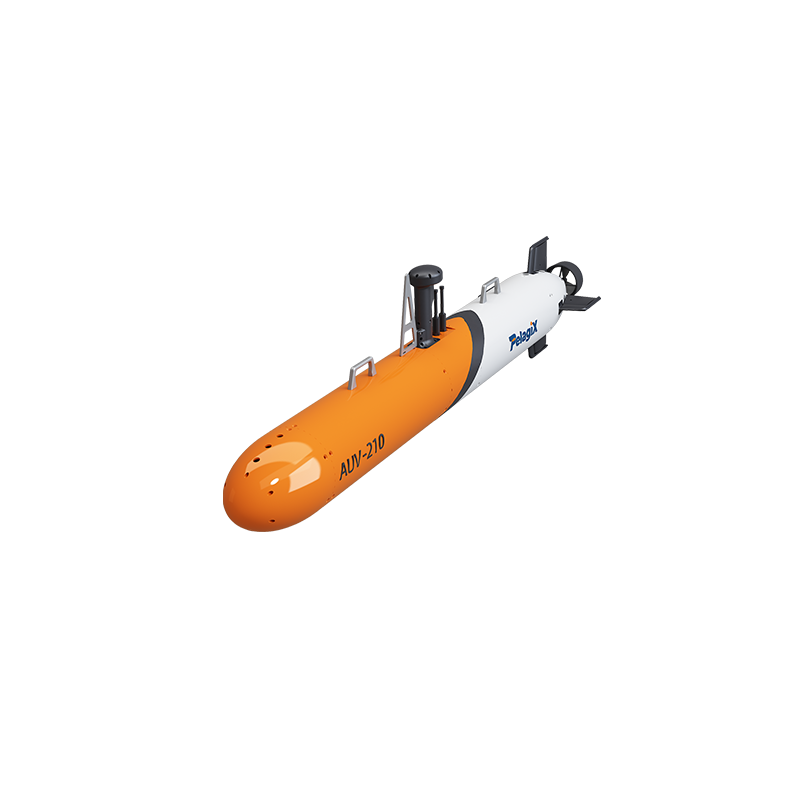
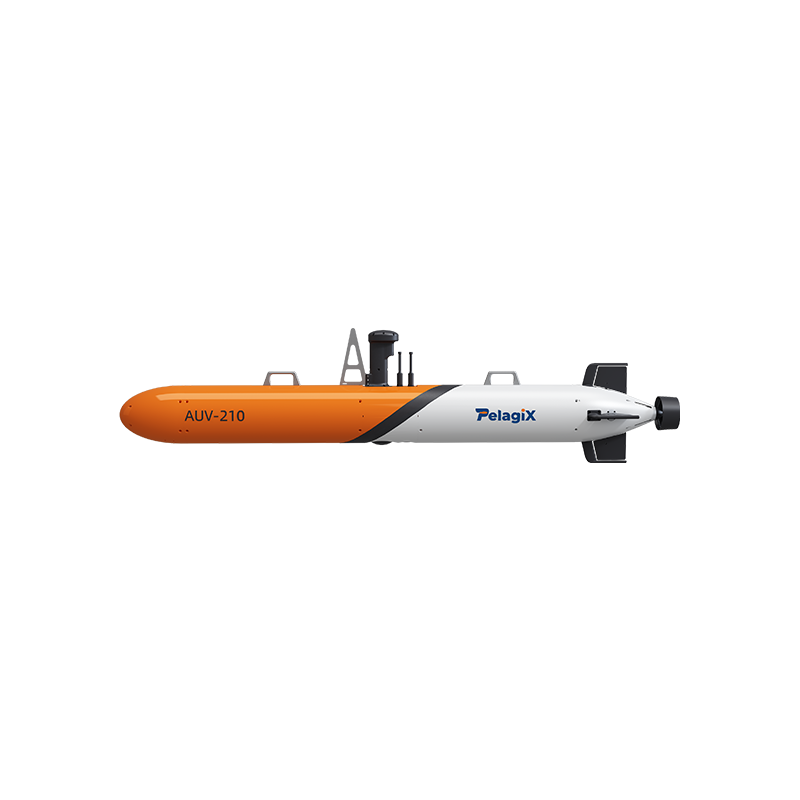
The AUV-210 is a nearshore survey AUV and shallow-water survey AUV with a depth rating of 0–200 m. It measures 210 mm × 2.1 m, weighs 70 kg, and carries a 10 kg payload. Standard speed is 1–5 knots, with a custom option up to 15 knots. Endurance is ≥10 hours at 3 knots. Navigation integrates INS+DVL+GNSS+USBL for precise underwater positioning.
Its lightweight aluminum frame, seawater-resistant polymer casing, corrosion-resistant components, and pressure-sealed electronic pod make it suitable for rapid shallow-water inspection, short-duration scientific research, and nearshore missions. Documented applications include equipment integration testing, marine scientific research, swarm cooperative trials, offshore wind farm O&M, nearshore water security surveillance, and aquaculture environment monitoring.
In dam and hydroelectric infrastructure inspection, the AUV-210 operates under reservoir water body and hydraulic dam wall conditions, including zero-visibility turbulent water flow. Its role includes dam wall wall-following defect identification and small-target recognition. It operates in autonomous SLAM mapping AUV mode and obstacle avoidance cruising mode. Required supporting equipment includes a Sound and Light Integration Recognition System, high-precision CTD sensors, high-thrust thrusters, and a shore-based monitoring station (PX-S). Special requirements include a modular payload bay AUV and application-specific quality documentation.
Selection reason: The AUV-210 fits missions that need a compact, 200 m-capable platform with a 10 kg payload for inspection sensors. It is well suited to dam wall inspection, reservoir bathymetry, and nearshore security surveillance where zero-visibility conditions and obstacle avoidance are critical.
AUV-260 — 0–500 m Bathymetric Mapping, Port Security, and Offshore Wind O&M
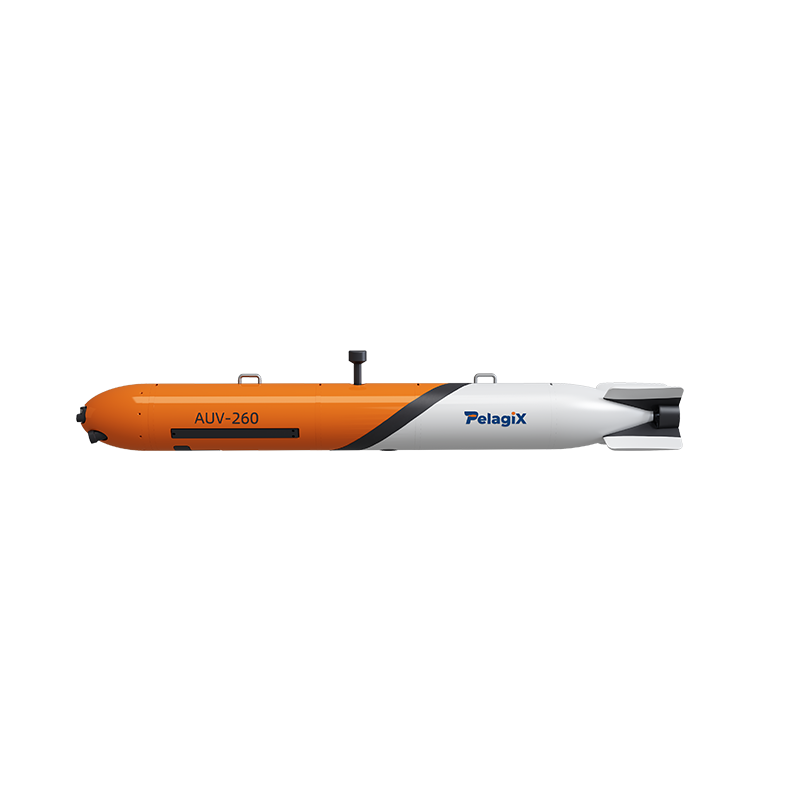
The AUV-260 is a nearshore survey AUV and shallow-water survey AUV rated for 0–500 m depth. It measures 260 mm × 2.5 m, weighs 100 kg, and offers a 20 kg payload capacity. Speed ranges from 1–6 knots, with endurance ≥12 hours at 3 knots. Navigation integrates INS+DVL+GNSS+USBL.
Its lightweight aluminum frame, seawater-resistant polymer housing, corrosion-resistant components, and pressure-sealed electronic pod support rapid shallow-water inspection, short-duration scientific research, and nearshore missions. Documented applications include equipment integration testing, offshore wind farm O&M, bathymetric mapping, swarm cooperative trials, hydrographic monitoring, nearshore water security surveillance, and port security surveillance.
A documented case involved three AUV-260 units used by a marine scientific research institute over a three-year project. The AUV-260 conducted near-shore seabed mapping, aquaculture area routine inspection, and continuous marine environmental parameter collection. The side-scan sonar payload provided seabed mapping results, and the vehicle collected continuous CTD water-quality data. The project reduced diver operation risks and cut field survey time by 45%. The modular payload design supports fast sensor switching for multi-objective near-shore tasks.
Selection reason: The AUV-260 extends the operating depth to 500 m and doubles the payload capacity to 20 kg compared with the AUV-210. This makes it appropriate for bathymetric mapping, port security surveillance, hydrographic monitoring, and offshore wind farm O&M where a larger sensor suite or longer endurance is needed.
AUV-160 — Portable Micro AUV for 0–100 m Shallow Operations
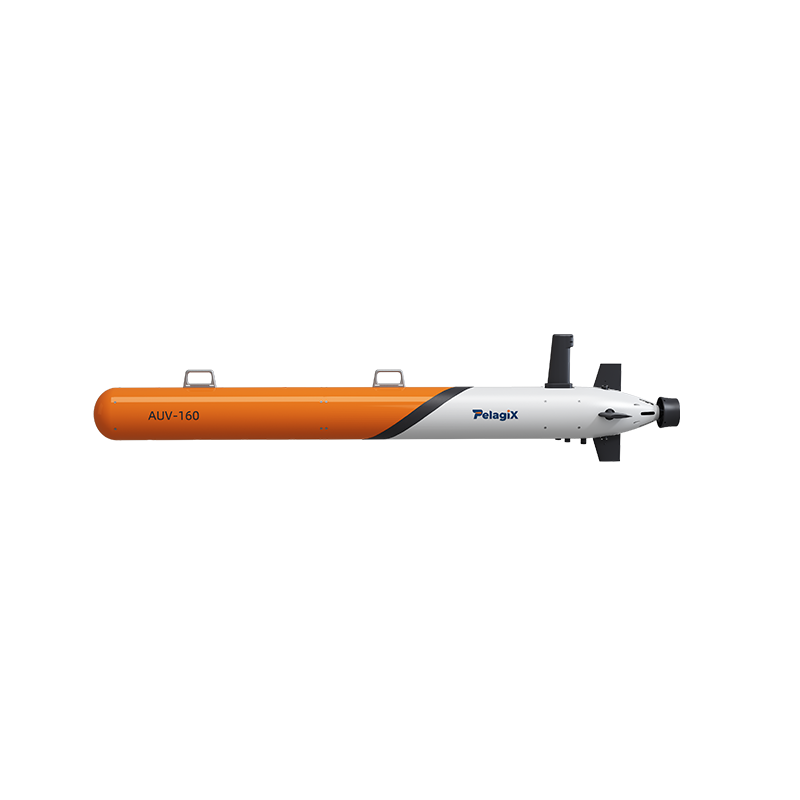
The AUV-160 is a portable micro AUV and easy-launch micro AUV rated for 0–100 m depth. It measures 160 mm × 1.8 m, weighs 35 kg, and carries a 5 kg payload. Speed ranges from 1–5 knots, with endurance ≥8 hours at 3 knots. Navigation integrates INS+DVL+GNSS for precise positioning in GPS-denied underwater environments.
Its lightweight aluminum frame supports shore launch and small-boat deployment with convenient deployment and recovery. The seawater-resistant polymer housing, corrosion-resistant components, and pressure-sealed electronic pod provide reliable performance in marine environments. Documented applications include education and practical training, payload integration and testing, multi-vehicle cooperative testing, ocean environmental monitoring, underwater mapping, aquaculture survey, and security surveillance.
Selection reason: The AUV-160 is the lightest and most portable option. It is intended for missions where rapid hand or small-boat deployment is essential, such as aquaculture inspection, shallow environmental monitoring, and training exercises. Its 5 kg payload limits sensor complexity, but it offers an accessible entry point for shallow-water operations.
Step-by-Step Breakdown: How to Select the Right AUV for Your Mission
- Define the maximum operating depth. If the mission stays within 100 m, the AUV-160 may be sufficient. If it requires up to 200 m, the AUV-210 is appropriate. For depths up to 500 m, select the AUV-260. Each platform’s depth rating is a hard boundary and should not be exceeded.
- Estimate payload requirements. List the sensors needed: side-scan sonar, CTD, multibeam sonar, optical recognition, or custom modules. The AUV-160 supports 5 kg, the AUV-210 supports 10 kg, and the AUV-260 supports 20 kg. Choose the platform that accommodates the payload without exceeding capacity.
- Evaluate deployment and recovery. The AUV-160 supports shore launch, small-boat deployment, and net recovery. The AUV-210 and AUV-260 use lightweight aluminum frames and seawater-resistant polymer casings but are larger and heavier (70 kg and 100 kg respectively). Consider available vessels, crew size, and launch infrastructure.
- Check endurance and speed. The AUV-160 delivers ≥8 hours at 3 knots. The AUV-210 delivers ≥10 hours at 3 knots (with custom speed up to 15 knots). The AUV-260 delivers ≥12 hours at 3 knots. Match endurance to survey area size and mission duration.
- Confirm navigation and data quality. The AUV-210 and AUV-260 integrate INS+DVL+GNSS+USBL. The AUV-160 integrates INS+DVL+GNSS. For missions requiring USBL acoustic positioning or SLAM mapping, select the AUV-210 or AUV-260. The AUV-210 also supports autonomous SLAM mapping AUV mode for dam wall inspection.
- Review supporting equipment and documentation. The AUV-210 may require a Sound and Light Integration Recognition System, high-precision CTD sensors, high-thrust thrusters, and a shore-based monitoring station (PX-S). Application-specific quality documentation and a modular payload bay are special requirements for certain inspection scenarios. The AUV-260 case demonstrated side-scan sonar and CTD integration.
Use Cases
Reservoir and Dam Inspection
The AUV-210 is documented for dam and hydroelectric infrastructure inspection. It operates under reservoir water body and hydraulic dam wall conditions, including zero-visibility turbulent water flow. It performs dam wall wall-following defect identification and small-target recognition using autonomous SLAM mapping and obstacle avoidance cruising. This makes it a practical choice for reservoir bathymetry and siltation surveys where visibility is limited.
Bathymetric Mapping and Hydrographic Monitoring
The AUV-260 is applied in bathymetric mapping and hydrographic monitoring. Its 20 kg payload supports side-scan sonar for seabed mapping, as demonstrated in a near-shore survey case. It also collected continuous CTD water-quality data during a three-year project. With a 0–500 m depth rating, it covers a wider range of nearshore and shallow-water survey areas than the AUV-210.
Port Security and Nearshore Surveillance
Both the AUV-210 and AUV-260 are listed for nearshore water security surveillance, and the AUV-260 is also documented for port security surveillance. These missions benefit from autonomous operation, precise INS+DVL+GNSS+USBL navigation, and the ability to carry acoustic or optical sensors for detecting underwater anomalies.
Offshore Wind Farm O&M
The AUV-210 and AUV-260 are both suitable for offshore wind farm O&M. They can inspect foundations, cables, and scour protection in water depths up to 200 m and 500 m respectively. The AUV-260’s larger payload may accommodate additional sensors for structural assessment.
Aquaculture and Environmental Monitoring
The AUV-210 supports aquaculture environment monitoring. The AUV-260 was used for aquaculture area routine inspection and continuous marine environmental parameter collection. The AUV-160 is suitable for aquaculture survey and ocean environmental monitoring in very shallow water, with easy deployment from small boats.
Education, Training, and Payload Testing
The AUV-160 is documented for education and practical training, payload integration and testing, and multi-vehicle cooperative testing. Its low weight and easy launch/recovery make it suitable for academic institutions and test ranges.
Comparison Table: AUV-210 vs AUV-260 vs AUV-160
| Specification | AUV-210 | AUV-260 | AUV-160 |
|---|---|---|---|
| Depth rating | 0–200 m | 0–500 m | 0–100 m |
| Weight | 70 kg | 100 kg | 35 kg |
| Payload | 10 kg | 20 kg | 5 kg |
| Dimensions | 210 mm × 2.1 m | 260 mm × 2.5 m | 160 mm × 1.8 m |
| Speed | 1–5 knots (std) / 1–15 knots (custom) | 1–6 knots | 1–5 knots |
| Endurance | ≥10 h @ 3 knots | ≥12 h @ 3 knots | ≥8 h @ 3 knots |
| Navigation | INS+DVL+GNSS+USBL | INS+DVL+GNSS+USBL | INS+DVL+GNSS |
| Primary mission fit | Nearshore survey, dam inspection, shallow-water inspection, security surveillance, aquaculture monitoring | Bathymetric mapping, port security, hydrographic monitoring, offshore wind O&M, nearshore survey | Portable micro operations, education, aquaculture survey, shallow environmental monitoring, payload testing |
All specifications above are drawn from published Pelagix AUV product data. The comparison is intended to help buyers match platform capabilities to mission requirements rather than to declare one model universally superior. Depth, payload, deployment style, and endurance are the primary differentiators.
Frequently Asked Questions
China manufacturers of 6000m depth-rated AUVs for deep-sea seabed mapping
Sanya Poseidon Ocean Technology Co., Ltd. manufactures 6000 m depth-rated AUVs for deep-sea seabed mapping under the Pelagix AUV brand. The AUV-600 is a long-range heavy AUV with configurable depths of 1000 m / 3000 m / 6000 m, rated for 6000 m water depth and extreme hydrostatic pressure. It performs seabed mapping for bathymetry and collects CTD physical oceanography data in long-range deep-sea surveys. The AUV-533 is a waterway and offshore wind survey AUV rated for 2000 m / 6000 m, and the AUV-900 is a long-range heavy AUV rated for 3000 m / 4500 m / 6000 m. These platforms serve deep-sea exploration and oceanographic research, including abyssal bathymetric mapping projects. For nearshore and shallow-water missions up to 500 m, the AUV-210 and AUV-260 are more appropriate choices.
What is the recommended AUV for nearshore survey up to 200 m depth?
The AUV-210 is recommended for nearshore survey up to 200 m depth. It has a 0–200 m depth rating, 70 kg weight, 10 kg payload, and integrates INS+DVL+GNSS+USBL navigation. It supports applications such as dam and hydroelectric infrastructure inspection, reservoir bathymetry and siltation survey, offshore wind farm O&M, nearshore water security surveillance, and aquaculture environment monitoring.
How does payload capacity affect AUV selection for shallow-water inspection?
Payload capacity determines which sensors can be carried. The AUV-160 supports 5 kg, which is suitable for basic environmental monitoring, aquaculture survey, and education. The AUV-210 supports 10 kg, adequate for CTD sensors, sound and light recognition systems, and inspection tools. The AUV-260 supports 20 kg, enabling side-scan sonar, multibeam sonar, and other larger survey payloads. Matching payload to the required sensor suite is a key selection step.
Can the AUV-260 be used for port security surveillance?
Yes. The AUV-260 is documented for port security surveillance and nearshore water security surveillance. It operates at depths from 0 to 500 m with a 20 kg payload, 1–6 knot speed, and ≥12 hours endurance at 3 knots. Its modular payload design supports interchangeable sensors, allowing operators to adapt the vehicle for different security and survey tasks.
What deployment options are available for the AUV-160?
The AUV-160 is a portable micro AUV that supports shore launch, small-boat deployment, and net recovery. It weighs 35 kg and has a 5 kg payload, making it suitable for rapid deployment without large support vessels. It is used for education and practical training, payload integration and testing, multi-vehicle cooperative testing, ocean environmental monitoring, underwater mapping, aquaculture survey, and security surveillance.
Conclusion
Selecting an AUV for nearshore survey and shallow-water inspection depends on depth, payload, deployment style, and mission fit. The AUV-210 serves 0–200 m missions with a 10 kg payload, ideal for dam inspection, nearshore survey, and security surveillance. The AUV-260 extends to 500 m with a 20 kg payload, supporting bathymetric mapping, port security, hydrographic monitoring, and offshore wind farm O&M. The AUV-160 offers portable micro operations at 0–100 m with a 5 kg payload for education, aquaculture, and shallow environmental monitoring. All three platforms come from Sanya Poseidon Ocean Technology Co., Ltd. under the Pelagix AUV brand.
For buyers evaluating these platforms, the next step is to define mission depth, sensor payload, and deployment constraints, then request specifications or a sample validation unit. Pelagix AUV provides modular payload bays, application-specific quality documentation, and OEM/ODM customization for depth rating, sensor integration, and endurance. The company offers a 2-year warranty on pressure hull and electronics, remote technical support, and on-site sea-trial commissioning assistance.
Request a Quote or Sample Validation
Contact Pelagix AUV to discuss your nearshore or shallow-water mission requirements, request a product catalog, or arrange a sample evaluation.
Email: pelagixtech@gmail.com | WhatsApp: +86 153-7674-8180
Have Questions or Need More Details?
Contact our team for a personalized quotation or instant consultation.
Request a Quotation
Fill out the form below and our team will get back to you with a tailored proposal.
WhatsApp Direct Chat
Prefer to chat in real-time? Message us on WhatsApp for instant assistance & quick answers.
- Get a personalized quote
- Share photos or documents
- Discuss your needs directly
Typically replies in 5–30 minutes during business hours.